

Press Release
August 20, 2026
Hamamatsu Water Symphony
Japan's First Successful Validation of "Flow-Through Warm Water Land-Based Aquaculture" Utilizing Surplus Heat Energy,
Achieved by HWS with Veolia
Achieving Approximately 30-Fold Production Efficiency and 15–20% Cost Reduction to Build a Sustainable Circular Economy Model with Hamamatsu's Local Industry
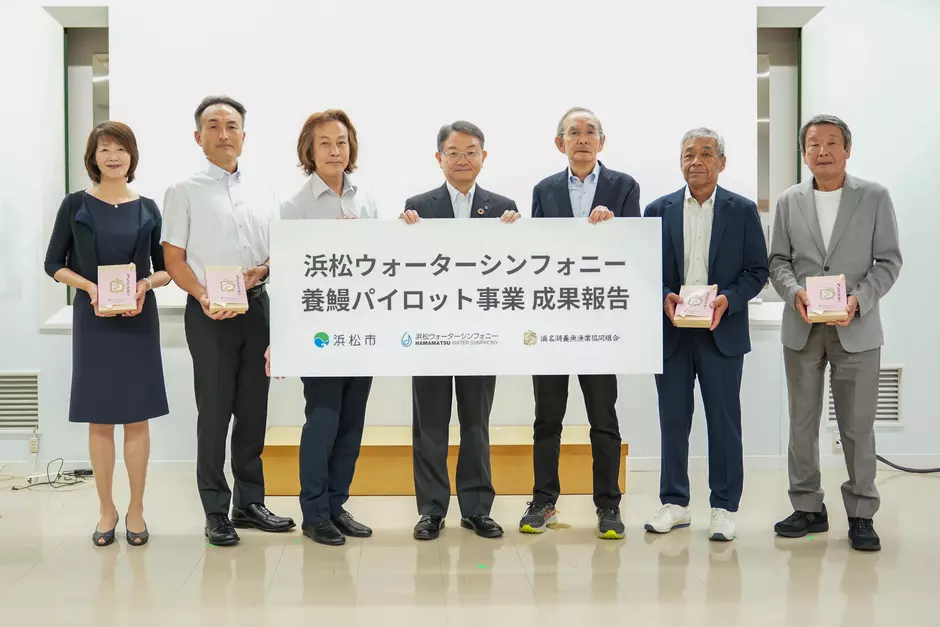
Hamamatsu Water Symphony Corporation (Headquarters: Hamamatsu City, Shizuoka Prefecture, Representative Director: Masazumi Kumagai, hereinafter HWS) held a results report meeting and tasting event for the sustainable eel farming pilot project at the Seien Sewage Treatment Plant in Hamamatsu City, which is managed as part of the operation of the Hamamatsu City Public Sewage Treatment Plant (Seien Treatment District), utilizing surplus heat energy generated from the sludge treatment process and existing water treatment equipment, today.
In this pilot project, by introducing a proprietary control technology currently under patent application, HWS successfully reduced warm water consumption to 1/5 of the original plan while achieving a 6-fold increase in stocking density (reaching 18% stocking density by the end of this month). This milestone marks an approximately 30-fold improvement in production efficiency compared to the original plan. Furthermore, HWS established a clear projection to reduce production costs by approximately 15–20% (excluding immature eels) compared to traditional recirculating aquaculture systems (RAS). At the tasting event held after the presentation, kabayaki (broiled eel) made from eels actually cultured at this facility was served to attendees, receiving high praise for its exceptional quality and taste worthy of the local tradition.
The event was attended by the Mayor of Hamamatsu, the Hamamatsu City Water and Sewerage Services Administrator, the Representative Director and Managing Director of the Hamanako Aquaculture Fisheries Cooperative Association, the Representative of the Hamamatsu Eel Sales Association, the Chairman of the Hamamatsu Eel Restaurant Promotion Association, other local stakeholders from the eel farming industry, and the Chairman of Veolia Japan G.K., the representative partner of HWS.
■ Key Demonstrated Results
This pilot project has been conducted since 2025 under a three-way partnership among HWS, Hamamatsu City, and the Hamanko Aquaculture Fisheries Cooperative Association, validating the technology over more than a year to establish a sustainable aquaculture technology that does not depend on fossil fuels.
The key results validated this time are as follows:
- Stocking Density Increased to 6 Times the Original Plan (Reaching 18%)
Compared to the typical stocking density of 1–3% (equivalent to raising 10–30 kg of fish in a 1,000-liter tank) in conventional greenhouse aquaculture, the project is projected to reach 18% by the end of this month. - Water Exchange Rate (Warm Water Consumption) Reduced to 1/5
In contrast to the initially assumed 2,400% water exchange rate (replacing the entire volume once per hour) to maintain water quality, the project succeeded in reducing it to just 5 times a day (500% exchange rate) through water quality management. This enables the operation of eel tanks 5 times larger using the same limited waste heat energy. - Production Costs Reduced by Approximately 15–20%
Utilizing the unutilized low-temperature waste heat from the sewage treatment process completely eliminated heating fuel costs (A heavy oil). Furthermore, by adopting a "flow-through" structure that eliminates the need for large, complex filtration and recirculation equipment typical of high-density RAS, both initial capital expenditure (CAPEX) and operating expenses (OPEX), such as electricity, were successfully minimized.
■ Future Outlook
Based on these results of the pilot test (STEP 1), HWS will conduct a feasibility study (FS), including advanced data analysis, facility planning, and cost calculation, by March 2027. HWS plans to consult and reach an agreement with stakeholders to transition to full-scale demonstration testing (STEP 2).
When scaled to full-scale demonstration facilities, HWS aims to establish a production system capable of delivering approximately 90 tons annually, which is equivalent to the average annual production of a single local eel farmer in Hamamatsu (85 tons). Furthermore, in terms of environmental impact, utilizing all low-temperature waste heat generated from the sewage treatment plant's sludge incinerator can provide heat equivalent to approximately 1,300 m³ of A heavy oil per year, offering a high environmental potential to reduce annual CO2 emissions by approximately 3,500 tons as a substitute for fossil fuels.
HWS will continue to collaborate with local eel farming stakeholders to establish a new circular economy model, contributing to Hamamatsu's industrial development and sustainable regional growth.
*The definition of "Japan's first" refers to a method that uses surplus heat and disposes of used water at a sewage treatment plant.
###
About Hamamatsu Water Symphony:
Hamamatsu Water Symphony Corporation was established in May 2017 for the purpose of fulfilling the operation of the Hamamatsu City Public Sewage Treatment Plant (Seien Treatment District). The business includes the operation of Seien Sewage Treatment Plant, Hamana Pumping Station, Azou Pumping Station, including operation maintenance management, repair, and remodeling. The project period is from April 1, 2018, to March 31, 2038. The shareholders are Veolia Japan GK, Veolia Genets Co., Ltd., Tsukishima JFE Aqua Solution Co., Ltd., ORIX Corporation, Suyama Construction Co., Ltd., and Tokyu Construction Co., Ltd.