

Press Release
May 14, 2025
Hamamatsu Water Symphony
Veolia Japan with HWS pilots a Sustainable Eel Farming Pilot Project at Seien Sewage Treatment Plant
The commitment to the circular economy and the local community
Japan's first challenge to "flow-through warm water land-based aquaculture" utilizing surplus heat energy
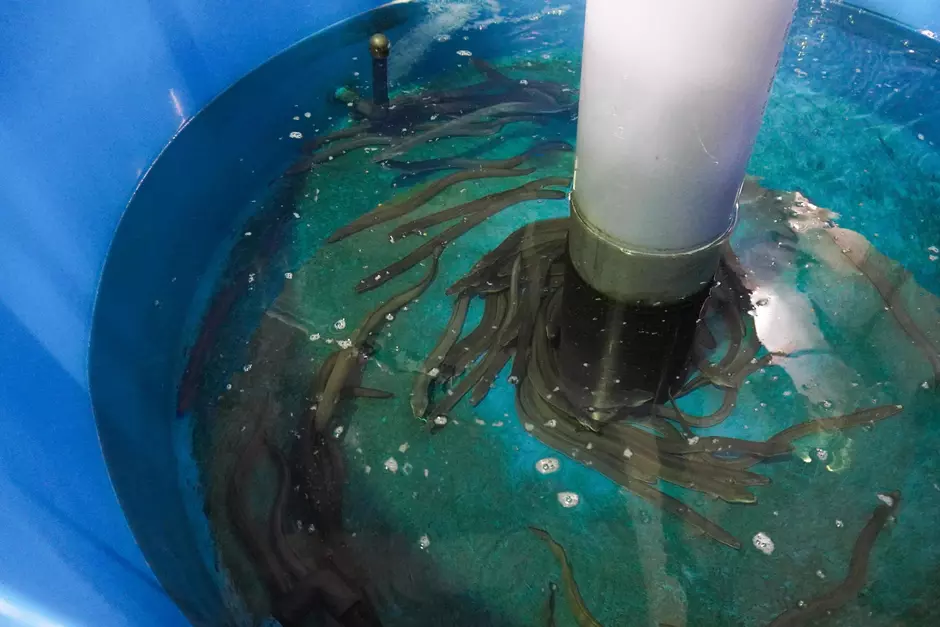
Hamamatsu Water Symphony Corporation (Headquarters: Hamamatsu City, Shizuoka Prefecture, Representative Director: Kazuhiro Uchino, hereinafter HWS) announced today the launch of a sustainable eel farming pilot project at the Seien Sewage Treatment Plant in Hamamatsu City, which is managed as part of the operation of the Hamamatsu City Public Sewage Treatment Plant (Seien Treatment District). This project aims to illustrate the benefits of the circular economy and the associated benefits for the local community by transforming the heat energy and water emitted from the sludge treatment process into sustainable food for the local community to enjoy.
The purpose of this project is not to engage in eel farming. We have set our objectives from our unique perspective as a sewage treatment plant maintenance operator. Specifically, our goals are to explore new value creation possibilities in the sewage business by utilizing previously discarded surplus heat and existing sewage treatment facilities' capabilities in novel ways, and to add sustainability elements to the local eel farming industry by introducing energy sources other than fossil fuels.
This project will be implemented under the partnership of HWS, which is the main promoter, the full support of Hamamatsu City, the owner of the facility, and the Hamanako Aquaculture Fisheries Cooperative Association, which provides immature eels and technical advice.
As part of the commitment to community engagement, , it is planned to distribute all the eels cultured during the pilot project period free of charge after being processed into kabayaki.
The features of this project are as follows:
1. Flow-through warm water land-based aquaculture
The large amount of low-temperature waste heat generated at the sewage treatment plant is usually discarded. By utilizing this to heat the water and feed it into the eel tank, we aim to establish a sustainable aquaculture technology that does not depend on fossil fuels. This is the first attempt in Japan to adopt this method.
2. Effective use of low-temperature waste heat
Dehydrated sludge, the fuel for the incinerator, is organic matter derived from biomass, so it is carbon-neutral even when incinerated. While medium-temperature waste heat of 100-300°C and high-temperature waste heat of 300°C or more are being utilized, the use of low-temperature waste heat of less than 100°C is not progressing. This project is expected to challenge this issue. If all the discarded low-temperature waste heat is used, an equivalent heat quantity of about 1,300 m³ per year in terms of A heavy oil can be obtained, and if this heat quantity can be used as a substitute for fossil fuels, it is possible to reduce CO2 emissions by about 3,500 tons per year.
3. Promoting understanding of sewage systems and eel farming business through the project
By choosing eel farming, an important industry in Hamamatsu City, as this project, we aim to contribute to citizens having more familiarity with and understanding of sewage systems and eel farming business.
This project will conduct a pilot test, and then, it will verify the technical superiority and cost-effectiveness of "flow-through warm water land-based aquaculture" at high stocking densities, which has never been done before.
*The definition of "Japan's first" refers to a method that uses surplus heat and disposes of used water at a sewage treatment plant.
###
About Hamamatsu Water Symphony:
Hamamatsu Water Symphony Corporation was established in May 2017 for the purpose of fulfilling the operation of the Hamamatsu City Public Sewage Treatment Plant (Seien Treatment District). The business includes the operation of Seien Sewage Treatment Plant, Hamana Pumping Station, Azou Pumping Station, including operation maintenance management, repair, and remodeling. The project period is from April 1, 2018, to March 31, 2038. The shareholders are Veolia Japan GK, Veolia Genets Co., Ltd., Tsukishima JFE Aqua Solution Co., Ltd., ORIX Corporation, Suyama Construction Co., Ltd., and Tokyu Construction Co., Ltd.